Showing posts with label genealogy. Show all posts

Monday, October 30, 2017

Memory Monday: Identifying Family in Old Photos


IDENTIFYING FAMILY IN OLD PHOTOS

Sometimes, I have a hard time looking at an old photo and recognizing who someone is. Other times, it is fairly easy to identify someone, even though the person has aged through the decades. I came across the picture above in a file of my husband’s family. These are three siblings—a brother and his sisters. Their names are Oval, Ira, and Vera. Obviously, I know which one is Oval, since he is the brother. The sisters are twins named Ira and Vera (and one of them was my husband’s grandmother). But who is who? I knew they weren’t identical twins. Both of these women have passed, so I can’t ask them. When I looked at a more recent picture of the two:


I know that the sister in red is my husband’s grandmother. The other one is her sister. When I look at the “old” photo, I can see the difference in the two women. Look at their chins in each picture, one has a more rounded chin, the other one has a more squared chin. Now, I know that the lady sitting in the black and white pic is my husband’s grandmother.

Then like I said earlier, I an old family photo of someone and can’t identify him in a second photo.
Here is a picture of my great-grandfather in his later years:


And here is a school picture of him:


Now, can you pick out which of these boys would be my great-grandfather? I can’t, so I just say this is a picture of him when he was in school in the 1860s—he was born in 1851.

How have you identified people in old photos? Have you ever been wrong? How did you go about figuring out who was who?


Monday, September 4, 2017

Memory Monday: Could It Be?

my sister in front of my grandmother's house


COULD IT BE?

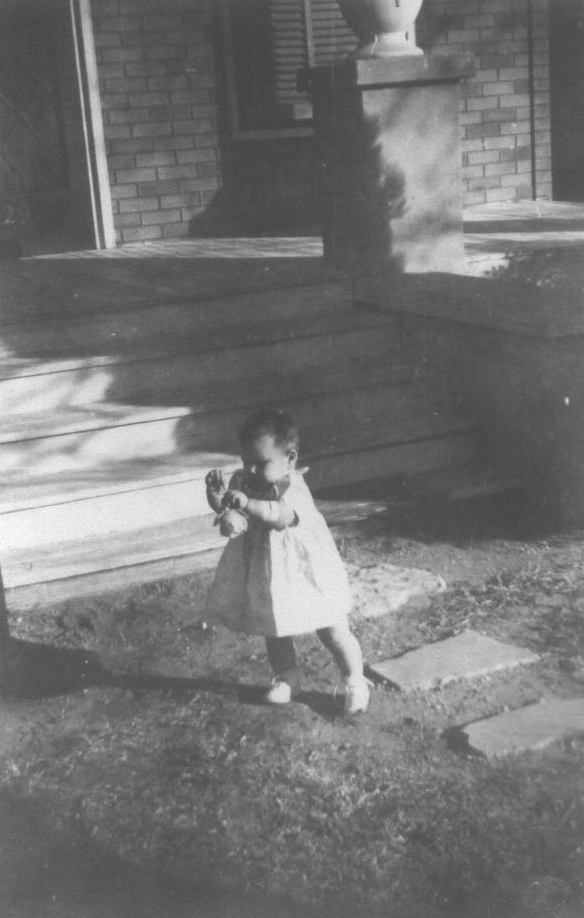
Last week as I was in the middle of re-posting my Thursday blog to several locations, something in the picture caught my eye. As I looked at the house in the background, something clicked. That house looked familiar in an odd way. You have to understand that that  photo had nothing written on the back of it to identify who was in the picture—I had just liked the look on the face of the woman. But the more that I looked at the house, the more I thought that I recognized it as my grandparents’.  The “bones” were the same—front door placement, windows placement, the height of the steps. The outside of the house was different. The posts were different. But my grandfather had bought the house sometime in the 1910s so it only make sense that some changes had been made in the sixty or so years that he owned it. I found a picture of the house (on Google Maps) as it looks now. It has siding covering it, as well as a metal handrail up the middle of the steps—the house was sold to an older couple years ago.

I remember the outside covered in a faux brick with concrete steps from a sidewalk up to the porch. The picture above was taken about 1949. Other than a block walkway and wooden (I think) steps, this is the way I remember the front of the house—even to the concrete planter on the concrete post on the porch by the steps.


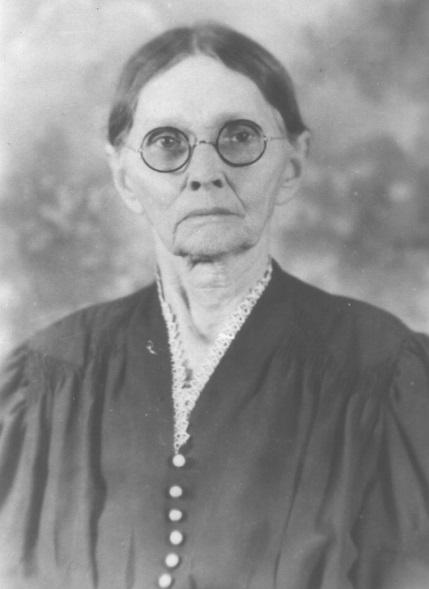
All this led me to take a closer look at the woman in the picture from last week. Who was she? I enlarged the face as much as I could. The eyes look a lot like my grandmother who passed away when my father was nine years old. I compared her wedding picture (the only one we have of her as an adult) to the lady with the baby.  The lady with the baby has a fuller face. But if this is my grandmother, she would have been about twelve years (and two children, if the child she is holding is my aunt) older. My daughter and husband both looked at the picture and couldn’t decide if it was the same woman, but we all agree that it might be her mother. Unfortunately, the only picture I have of my great grandmother (She died in 1927, a year after her daughter.) is below and I don’t think that it is her in the picture with the baby:


So this still leaves me with my question—Is the woman with the baby the same woman who posed for her wedding picture twelve years earlier? Do I have a “new” picture of my grandmother? Below are the two pictures I have been comparing:


This was taken from her wedding photo:


AND


The above is an enlargement of the picture below:


Do you think these are the same woman?


Monday, July 24, 2017

Memory Monday: Just How Accurate Are Those Family Stories?


My daddy, his sister, and their cousin

JUST HOW ACCURATE ARE THOSE FAMILY STORIES?
As I was growing up, it was always an exciting time when we got to go to my mother’s parents’ home. There were often a lot of relatives since several of my mother’s siblings lived somewhat nearby. And then there were the times when one sister decided to come “home” and then one or more of the sisters would plan on coming at the same time. It was during these visits that I learned a lot of family history. Later, after I interviewed (and taped) these get-togethers with my mother, aunts, and grandmother. I am pretty sure the stories that I got were accurate—at least, as accurate as older women wanted to share.

Now stories from my father’s side of the family are a little sparse. One reason is my father had only one sibling—my mother had six. Another reason is my father’s sister lived far away and we hardly ever saw them. While we visited my dad’s parents, those visits were usually day trips. We would leave early Sunday morning, stop along the way and go to church, then get to my grandparents’ home in time for a late lunch. We hardly ever stayed the night. Usually, when we went we just played outside while the adults visited.

All that was said to explain why I don’t have a lot of stories of my father’s family. From a few things my dad had told me, I was able to piece together some of his side of the family. And thanks to Ancestry.com, I have also been able to learn more about that part of my family (and a bit more accurately). My sister told me that when she questioned my dad’s sister (our dad had already passed away when she needed this information for a college class) that she was told our grandfather had run away from home when he was eleven because his new step-mother was so mean. When I hear a story like that, I’m thinking he never went back home (and my aunt never said he returned). Well, when I looked at the census for when he was a little older, he is listed there living with his father and step-mother. He might have “run away” to his older brother’s house, which was only a few streets away, but he eventually came back home.

Another story I heard years and years ago, was that after my granddad married for the second time (my dad’s mother had died eight years before) was that my dad went to stay with his aunt (his mother’s sister) and her family during his last year in high school because she and her husband had lost a son the year before. I always thought the cousin who died was in his teens, like my dad—see the picture at the beginning of the article. I thought this was the cousin who had passed away. But today, I was to look at Ancestry.com to see if I could find just when this cousin passed away and what his name was. I got another surprise. While it is true that my aunt and her husband lost a son the year before my dad came to stay with them, the son that passed away died the same day he was born. I really think the reason that my father spent that year with his aunt’s family was he didn’t get along with his new step-mother—he called her “Madam” then and I never heard him call her anything but “Myrtle” as I grew up.


I think I need to spend more time on Ancestry.com. Maybe I will learn more about my dad’s family. I wonder what other stories that I’ve heard aren’t exactly true.

Monday, May 15, 2017

Memory Monday: Two Unknowns in My Family History


My great-grandfather and his second wife


TWO UNKNOWNS IN MY FAMILY HISTORY

In the last few years, I have come to love working on my family’s genealogy. Both of my mother’s branches were from Mennonite backgrounds and there are many records to use. In the same manner, my father’s mother’s history is well-documented. I know where all three of these branches of my family came from, when they entered the United States, and thanks to US census records, I know where they lived, what their occupations were, and how many children they had and when/when they were born and died.
There is problem with my paternal grandfather’s family. I know what his name was, when he was born, and in what state. But that doesn’t narrow things down enough. There were a number of families in that state with the same last name and many of them named a son born about the same time with the same name. (GR-R-R). After following several of the different families in that state through the years, I was able to dismiss all but one. Several things point to this being the right family—the age for my great-grandfather’s birth is right, the states where his mother and father were born are correct, this man’s father and mother (although divorced some time before) both had moved to the county and state where my great-grandfather was married, and the man’s father later moved from Iowa to the same county in Texas were my grandfather was born. (Are you thoroughly confused so far?)
Now I have two problems with attaching this man as my great-grandfather’s father. The first is that on one—and only one, and that being when he lived in a boardinghouse— US census, this man is listed as having been born in Ireland. All the other censuses have him born in Georgia. The other problem is that on my great-grandfather’s death certificate, his father’s name is listed as “Isaac,” not “Michael” like the censuses I have been following. The information was listed by one of his sons, while the other son gave the information on their mother’s death certificate.  The second son listed their mother’s father’s name as “Isaac.” Were both of their grandfather’s names “Isaac” or was there a bit of confusion? After all, both of their parents died in their 70s, and their grandfathers had passed on decades before. Oh, well, I’ll just have to keep searching.
The other unknown is about my great-grandfather’s second wife—they are picture above. He and his first wife divorced in 1904 and he married again the next year—he was 53 and she was 26. Other than her name showing up on US censuses and city directories, I can fine no  other record of her—what her maiden name was, where she was born, if she had any other family, and what happened to her after my great-grandfather died after more than twenty years of marriage to her. It makes everything so incomplete.
Well, that’s two of the unknowns in my family. Do you have any of those kinds of unknowns in yours?

Monday, March 20, 2017

Memory Monday: A New Generation in Our Family

A NEW GENERATION IN OUR FAMILY


The title of this blog is FAMILIES ACROSS THE GENERATIONS. Well, we have added a new generation—officially—to our family this week!!! I have mentioned her a few times in past blogs, but I could never show her face until she was officially ours.

The first picture below is one I posted on my second blog post. It is my great-grandmother and her family, including my grandmother. The second picture is my grandmother, my mother, me, and my daughter (and son). The picture above is our latest "three generations" picture—me, my daughter, and my newly-adopted granddaughter. That’s a total of six generations—six generations of love shared, six generations of memories made and passed on, six generations that take us from the past to the present and on to the future.


May God bless the generations who come after me as He has blessed those who came before.

Monday, February 20, 2017

Memory Monday: Origin of Words


My Great-Grandfather's School Picture
ORIGIN OF POPULAR WORDS
As some of you may know, I put together and publish a “reprinted” historical magazine each month. I have been doing this for almost two years. The first edition was dated May 1865—just weeks after President Lincoln was assassinated. I “create” a new edition each month 150 years after the date listed on the monthly magazine—in May 2015, I did May 1865, June 2015, I did June 1865, and so forth.
Other than the front page, along with Letters to the Editor and Manners Matter columns, all the tidbits, articles and book chapters come right out of books and magazines published before the date of the magazine. It’s a lot of research, but I love it—and I learn a lot from it. Doing this also helps me connect with family members that lived during that time. These were the books and magazines that were available to my great-great-great grandparents as well as their children and grandchildren. My great-grandfather is in the picture above, although I’m not sure exactly which one he was. I do know that it was taken in Illinois because that where he lived at the time. Maybe, his mother read from some of the magazines I used. Maybe she read some of the children’s stories to my great-grandfather and my great-great uncles and aunts.
Anyway, one of the things I came across this last month in the bound book of The Ladies Repository, from 1865, was an interesting article. I will show part of it below:

BANKRUPT. Few words have so remarkable a history as this. The money-changers of Italy had, it is said, benches or stalls in the boruse or exchange in former times. At these, they conducted their ordinary business. When any of them fell back in the world and became insolvent, his bench was broken, and the name of broken bench, or banko rouo, was given to him. When the word was first adopted into English, it was nearer the Italian than it now is, being bankerout instead of bankrupt.
BIGOT. This word is not, as generally, supposed, of religious but of secular and political origin. Rollo, Duke of Normandy, receiving Gissa, daughter of King Charles, in marriage, and with her the investiture of the Dukedom, refused to perform the usual ceremony of kiss ing the king's foot in token of subjection unless the king would hold it out for that purpose, and when he urged it, answered hastily, "No, by God," whereupon the king gave him the nickname of by God or bigot, and the name has passed to all stubborn and peevish insisters on their own notions.
CANTEEN. This is, perhaps, the only word in our language which, originally English, passed into a foreign tongue and was afterward taken back in a modified form. As originally spoken by the Saxon it was simply a tin can; but the Gaul, as is his wont, placing the noun before the adjective, and pronouncing the letter i as e, brought it out as cantin, pronounced canteen. Adopting a thousand other French terms, the dull Englishman took back his own original word in a new shape without any inquiries on the subject, and hence we now say canteen instead of tin-can.
GROG. Admiral Vernon—the same after whom Mount Vernon was named—was the first to require his men to drink their spirits mixed with water. In bad weather he was in the habit of walking the deck in a rough grogram cloak, and hence had obtained the name of "Old Grog" in the service. Such was the origin of the name applied to rum and water.
HURRAH. Thousands of people have shouted "hurrah!" "many a time and oft," but comparatively few know its derivation and primary meaning. It originated among the Eastern nations, where it, was used as a war cry from the belief that every man who died in battle for his country went to heaven. It is derived from the Sclavonic word Hurraj, which means "to Paradise."
LADY. In an old work of the date of 1762 is the following account of the origin of the term lady: "As I have studied more that appertains to ladies than to gentlemen, I will satisfy you how it came to pass that women of fortune were called ladies even before their husbands had any title to convey the mark of distinction to them. It was generally the fashion for a lady of affluence once a week, or oftener, to distribute a certain quantity of bread to her poor neighbors with her own bands, and she was called by them hlaf-day; that is, loaf-giver, or as it is sometimes explained, the bread-giver. These two words were in time corrupted, and the meaning of the term is now as little known as the practice which gave rise to it."
WINDFALL. Some of the English nobility, by the tenure of their estates, were forbidden felling any of the trees upon them, the timber being reserved for the use of the royal navy. Such trees as fell without cutting were the property of the occupant. A tornado, therefore, was a perfect Godsend in every sense of the term to those who had occupancy of extensive forests, and the windfall was some times of great value.


If you wish to read all of the article, or if you wish to see the magazine archives for my magazine—Worbly’s Family Monthly Magazine, go to http://worblysmagazine.com/ It is a lot of fun to explore the world of the mid-19th Century.

Monday, September 26, 2016

Memory Monday: Pictures of Family Connected by History

My Great-Grandfather

PICTURES OF FAMILY CONNECTED BY HISTORY
Sometimes as I go through the old family pictures, I tend to lose touch with the people in the pictures. I know who they are, after all, their names are written (sometimes) on the back of the pictures. But after a while of going through them all, they just become photos. I lose the connection to the family unless I have personally known them.
One of the things that has helped me is to try to connect these people with events in history or in the lives of the family members I have known. The man pictured above is my mother’s grandfather on her father’s side of the family. While he was born in Russia in 1872, he came to America in 1892, then settled and married in 1895 while living in Kansas. Now I don’t know what Russia was like in 1872, but I have done enough historical research to know what life was like in Kansas at that time. I can imagine him, his wife (who also migrated from Russia), and their children living and farming on the flat plains of Kansas. I now can get a sense of my great-grandparents, and maybe a little of what my maternal grandmother’s life was like as a small child.
This great-grandfather passed away in 1944—toward the end of the Second World War (and well before I was born). My father and father-in-law both served in that war. I have heard stories from both of these men about growing up in Texas and what life was like at that time. That also helps me to “see” my great-grandfather and the way he might have lived.

While I will never have the connections to people before my grandparents’ generation that I have with the people I have known, talked to, and loved, I can still get a sense of those who came before and maybe, just maybe, be able to pass that on to the generations that come after me.

Monday, September 12, 2016

Memory Monday: Things May Not Always Be What They Seem

Picture Found in My Grandparents' Photobox

THINGS MAY NOT ALWAYS BE WHAT THEY SEEM

Ever since my mother passed away and I came across a box of my grandparents’ pictures, I have wanted to discover who came before me. I tried to remember things that my mother and her sisters had told me. That, along with Ancestry.com, I have been able to trace back both sides of her family. Of course, I was really helped by the fact that my mother’s side was Mennonites from way back, and a lot of the extended family had already researched and posted about them.
My dad’s side of the family was not so easy. Now his mother’s side of the family wasn’t hard to track down, especially since a lot of that family’s history had previously be recorded (before Ancestry). The problem has always been my paternal grandfather’s side of the family. From my grandfather’s (delayed) birth certificate, I learn my great-grandfather’s name was John. Using that info, I researched the 1880 census and found him, his wife and his children. But I wanted more. I wanted to discover John’s parents and siblings. Looking again through the pictures, I thought I had found a clue when I came across the children in the picture above with the names “John, Opal, and Emmitt” written on the back. Could this be “my” John?
I searched and searched but couldn’t find anyone with my family’s last name and children with the names listed on the picture that fit in with what I knew about my great-grandfather. Later, I was able to find my great-grandfather in the 1860 census, so I now know the names of his parents. But I still didn’t know who the people in the picture were. Who was this “John” and why had my grandfather kept his picture?

For my birthday this year, my husband gave me an Ancestry DNA test. With that, I keep checking on people to whom I might be related. One day, I came across something. When I researched it a bit more, I discovered that my grandfather’s brother had three children named (have you guessed it already) John, Opal, and Emmitt. That mystery is solved, but I’m still trying to track down my great, great-grandfather—John’s father. 

Monday, June 27, 2016

Memory Monday: All the Family History Is Not Lost

Papaw, Mamaw, and my father, 1940s
ALL THE FAMILY HISTORY IS NOT LOST

Both of my parents and all of my grandparents have passed away. They all died before I developed an interest in family history (at least for the most part. I remember having a conversation with my Daddy about 35 years ago when he told me somethings that he remembered about his mother’s family—just general things—but I didn’t think to write any of them down).
My mother lived the last 25 years or so of her life in the same town as I lived. Her sisters visited and we had several family reunions with her side of the family. Both of which allowed me to learn about her side of the family, especially about the years she was growing up.
I had nothing like this for my Daddy (this is the name we always called my father)—just a few facts he had given us for our daughter’s baby book. But I have learned of a wonderful tool to peek into the life of my father—Ancestery.com. Below are a few of the things that I have learned just looking into the past censuses.

1920 census
Lived in house on Kirkwood
Papaw worked in a grocery store
Papaw, Daisy (my grandmother), Daddy
1930 census enumerated on April 12th
Papaw-Widowed, Same house, owns house valued at $3500, owns radio, works as a salesman in retail grocery
Daddy—12 years old
Aunt—9 years old
Grandmother—77 years old, widowed
Great-uncle (deceased grandmother’s brother)-salesman in bakery
Great-aunt
Their three children—ages 2, 6, and 9
1940 census enumerated April 10th
Papaw-same house, worked as a stock clerk in a grocery store for 52 weeks in 1939 and earned $1560, a week before census he worked 48 hours, he had completed 4 years of high school
Mamaw (step-grandmother), worked in home—housework, she completed 4 years of college
Daddy—attended college, worked as clerk for 52 weeks the year before and earned $1020, week before census he worked 36 hours
Aunt, attended high school (fourth year), worked as a waitress in 1939 for 15 weeks and earned $120, a week before the census she worked 48 hours
Mamaw’s mother—71 years old, lived in the same house for 5 years, attended high school for 2 years
Daddy’s military service
Enlistment Date: 2 Feb 1942
Release Date:  9 Jan 1946
Branch  Army Air Corps
Grade   Private
Term of Enlistment:  Enlistment for the duration of the War or other emergency, plus six months, subject to the discretion of the President or otherwise according to law Component Army of the United States - includes the following: Voluntary enlistments effective December 8, 1941 and thereafter; One year enlistments of National Guardsman whose State enlistment expires while in the Federal Service
Height   69 Weight 132

From the information above, I have learned several things about Daddy that I can put together with the things I already knew. I was very familiar with the house my grandfather (we called him Papaw) lived in because we visited him quite often as I was growing up. It was a small two bedroom/one bath house with a screened-in back porch. I didn’t know that he had lived there from at least 1910. He still owned it at his death in 1974. I knew that his mother (whom we always referred to as Daisy, probably because we grew up with a step-grandmother we called Mamaw) died from double pneumonia when Daddy was 9 years old. I didn’t know that in 1930, Papaw had taken in his widowed mother and his brother-in-law, along with his family—that was 9 people living in that two bedroom house (with screened –in porch). He also owned a radio—can’t you just see them all sitting around in the evening and listening to it—just like the Waltons. Ten years later, Papaw’s mother had passed away (I know this from other Ancestry records) and his brother-in-law’s family had moved out. Also, Papaw had married again and had taken in his new mother-in-law. As Papaw worked in a grocery store all those years to provide for his family, Daddy and his sister attended school and worked outside the home.
Also, Ancestry showed me that Daddy enlisted in the Army Air Corps less than two months after the attack on Pearl Harbor and was released January, 1946. I knew that he had left the army with the rank of staff sergeant because that was what he written in a few books he had acquired during the war and were in the bookcase mother had built him (see the post from 12-14-2015). Daddy met the lady who became my mother about the first of July, 1946 and they were married in the middle of July (Mother always said they married two weeks after meeting and their marriage lasted 38 years).

Have you every researched your family on Ancestry? What did you learn about your family?  

Monday, May 23, 2016

Memory Monday: Modern Conveniences of the Time

My maternal great-grandmother
My great-grandmother was born in Russia and came to America as part of the great Mennonite migration.  She married in 1889 while living in Kansas. I’m not she ever read the book 1000 Shorter Ways Around the House: A Handbook of the Horne, The Building, the Furnishing and the Work Therein by Mae Savell Croy, published in 1916. I’m not even sure she could read English. I know her daughter (my grandmother) could. But even if my great-grandmother couldn’t read about these modern conveniences, she might have seen them in the local mercantile.
As you read through these new-fangled items, what do you think about them? Would you like to use them? Would they help you and save time in your day?
For keeping food warm a hot water platter is most satisfactory as the lower vessel can be filled with hot water and a plate set on this any length of time without injury to the china. They are very cheap in price.
A combination mayonnaise mixer, egg beater, and churn comes in glass, enabling one to see just when the ingredients are properly mixed. They are in various sizes and at different prices.
An egg fryer made of aluminum and shaped so that the sections containing the eggs do not rest directly upon the stove is made with a long handle, and each egg being in a separate compartment is cooked in nicely rounded shape.
An excellent dish-washer is a string-mop with a rectangular brush set in one side. The tool is small enough to allow the mop to be used for washing cups and glasses, while any material that has a tendency to stick can be loosened by means of the brush. Dishes can be washed rapidly by it without a dish pan and with merely a fine stream of hot water from the faucet. Only silver and glassware require drying.
An inexpensive silver-clean-pan renders the task of cleaning silver an easy one. The process of cleaning is merely to put a little salt and soda in hot water and pour into the pan and let the silver soak in the solution for half an hour. If it is then washed with soapy water no tarnish will remain.
A gas-saver consists merely of a piece of sheet metal lined with asbestos. When placed over a gas-flame, three irons can be more evenly heated than over the burner alone and in less time. Four irons can be heated and kept going on ironing day.
I think these items should stay in the books as curiosities of a bygone era. Give me a microwave, a dishwasher, stainless steel flatware, and NO asbestos, thank you very much.
What are your thoughts on these modern conveniences?

Monday, April 11, 2016

Memory Monday: Facial Hair in My Family

Me, my husband, and our son

FACIAL HAIR IN MY FAMILY
One year after my husband went with our son to Boy Scout summer camp for a week, he came home with a beard, which he thought would make me fuss and cry out when he tried to snuggle with my neck. What he hadn’t realized was that the hair on his face had grown long enough that it wasn’t scratchy any more. I loved it!!! I loved the look. I loved the feel of it. So he kept it—for twenty years!

As I looked through our family pictures, I noticed something. A lot of my ancestors had facial hair, too. Here are some of their pictures.
One of my paternal great-grandfathers
My other paternal great-grandfather


One of my maternal great-grandfathers

My other maternal great-grandfather


Now, I have to admit that I never saw my father, my father-in-law, and neither of my grandfathers with facial hair. As a matter of fact, I remember quite well talking to my father-in-law (who loved his son very deeply) about it one day years ago. He said he would never trust a man with facial hair (actually, I think he said a man with a mustache). I looked at him and asked what if his son had a mustache, and he said he would never trust him either (and my father-in-law wasn’t smiling).
What are your feelings about facial hair? Do you love it or do you hate it?


Monday, March 28, 2016

Memory Monday: My Family Just Got A Whole Lot Bigger

My paternal great-grandfather

MY FAMILY JUST GOT A WHOLE LOT BIGGER

Growing up, I knew the names of all my grandparents, aunts, uncles, and cousins. I didn’t think about the generations that came before me. But after I married, my husband had great-grandparents, great-aunts and great-uncles that were still living and that he knew. Shortly after wee married, his grandmother gave us a quilt that had been made for her mother and contained the names of several generations of her side of the family. My husband even had a book that a couple of his great-uncles had researched and put together tracing the family back to the first of the family that came to America in the early 1700s. Later, I remember talking to my father about his ancestors, but I failed to ask the right questions, so I didn’t get names, dates, or states where they came from. When he passed away, all that information went with him.
Years later when our daughter was in her early teens and we got internet, she and my husband would search the different sites, tracking back his side of the family. I tried it for a little while, but since I didn’t have enough information, it was hard and I got discouraged, then quit.
Again years later after my mother passed away, I found my paternal grandfather’s delayed birth certificate among her papers. And as we all know, it listed his parents’ names. This was astounding! I never knew what their names were. Also among those papers was a death notice which listed his late brother and where he had been born.
With this information, I got on the computer and did a quick search. In the free 1880 census, I found them!!!! My family (well, of course my grandfather hadn’t been born in 1880) were now names and dates, not some unknown cloudy shadows drifting about in the mist of history.
In this burst of enthusiasm, I started researching the rest of my ancestors. Through the years, we subscribed to Ancestry and I have been able to trace back three branches of my parents’ families—two for my mother (they were Mennonites and well-documented) and one for my father (his mother’s side was also well-documented). But I could only go back as far as my paternal great-grandfather. I researched and researched, but could find anything that I could connect to. I eventually found a family that there might be the next generation back. But try as hard as I could, I couldn’t make a definite connection (and if I was going to do this, I wanted it to be right).
Then last night—when I couldn’t sleep (now I’m not saying it was because my husband was snoring, let’s just say I had been drinking too much coffee earlier), I got on the computer and started looking again. Suddenly, it was there! A second or third cousin, probably several times removed, had my paternal grandfather’s family listed, and it went back to 1520. WOW!!! I’ll not say I screamed in my excitement, after all my husband was still sleeping. But my family had just increased by whole lots—and I had the names with their birth, marriage, and death dates to prove it.

I now know when all parts of my family came to America and where they come from. This is wonderful information that I can pass down to the generations that come after me.

Monday, February 8, 2016

Memory Monday: My Paternal Grandfather, A Man Who Suffered Much But Found Happiness

My Grandfather
A MAN WHO SUFFERED MUCH BUT FOUND HAPPINESS

Will Curry was my paternal grandfather. When I look at the picture above, I hardly recognize him. He looks so stern, sad, and almost hopeless. And then I think back on what I’ve heard about his life.
Here are some of the things I know about him:
--In 1904, his parents divorced when he was just a youngster. His mother, along with his sisters, left and moved to New Mexico with her new husband. He stayed with his father and his new wife (who was just about 10 years older than he was). At one time he left home because of the situation with her and moved in with his older brother—in the same town.
--At twenty, he married the woman he loved very, very much, but they had to wait for seven years for their firstborn (my father). They had a second child, a daughter, four years later. My grandfather was twenty-six and with two children—ages 9 and 4, when he became a widower. My grandmother developed double pneumonia and died. But he struggled through.
--Life was hard for my grandfather and his family. My father told me one of the jobs he had to do as a young boy for his father was to cut cardboard pieces to cover the holes in his father’s shoes so he could walk to the grocery store where he worked. There was just no money to buy new shoes or even to have them repaired. To make matters worse, sometime before 1930, his mother—now widowed—moved in with him, along with his late wife’s brother and his family. That made nine people living in a two bedroom house with a screened-in sun porch. (I know this house well. My grandfather still owned that house when I married. It was where we always went to visit him when we were growing up).
--When my father was sixteen, my grandfather married a widow. But things must not have been happy between my father and his step-mother, because my father went to live with his aunt and uncle in another town when my father was in his senior year of high school. My father never called his step-mother anything but “Myrtle” even though we always called her “Mamaw.”
--At approximately 78 years old, Papaw (which is what we always called him), left the home he had lived in for almost fifty years and moved into a nursing home with his second wife. She passed away in 1972—a week after I married, and Papaw moved in with my parents. He lived with them for two years before he fell, broke his hip and discovered he had cancer. He never left the hospital. He was 85 years old.


But the thing I remember most about my grandfather was how he learned to be content, even happy, after all the problems he had lived through.
Papaw and Mamaw
One last thing, our son shares the same middle name as my father, who shared the same middle name as his father. But my son also shares something else with his great-grandfather. Even though they never knew each other (my grandfather passing away in the mid-1970s, and my son not being born until the mid-1980s), they share the same birthday.


Monday, November 9, 2015

Memory Monday: Veteran's Day

My husband in 1972
THOSE WHO SERVED
As we approach Veterans Day, I wanted to share those in my family who served their country. 

My father with his parents during WWII
My father-in-law during WWII

Another uncle in WWII
My uncle - career military


My great grandfather during the Civil War


My husband's grandfather (on the right) during WWI


Besides the picture above, my husband-through his genealogy research-has discovered the names of more of his family who have served in the military. In the American Revolution, 18 of his direct ancestors served, while another one served in the post-revolution period. During the War of 1812, 3 of his ancestors served, while 8 served during the Civil War. I haven’t researched my family history, so I’m not sure how many of my ancestors served, although I know not as many as his because my mother’s family were Mennonites and didn’t come to America until much later than my husband’s family. Still I’m so proud of all my family, and that includes in-laws-who have served.