Showing posts with label Information. Show all posts

Monday, October 16, 2017

Memory Monday: Black Butter

my great-grandmother
BLACK BUTTER
While I was researching for my historical magazine last month, I came across an interesting recipe. Well, the recipe might not be all that interesting, but the name was—Black Butter. The more I looked at the recipe, the more I realized that I wanted to make it—especially with blackberries, which I love. It’s really a very simple recipe and I think it would be good on some warm homemade bread—I could do that with my bread machine. This recipe came from a book titled, The Ready Adviser and Family Guide. It was published in 1866—my great-grandmother would have been eleven at the time, so she may have made something like this.
Black Butter.—Put to any kind of ripe berries half their weight of brown sugar; mash and stew them gently for half an hour, stirring them frequently. This is a good substitute for butter spread on bread and is usually much liked by children, and is more healthy than butter, particularly for those afflicted with humors in the blood.
I have no idea what “humors in the blood” are, but blackberry spread would make anything better.
By the way, if you like history and things of the past, please take a look at my historical magazine at worblysmagazine.com Almost everything in it is taken from books and magazines published prior to 1868. Some of the hints and recipes from that time are very interesting to read.

What are some of the things your mother/grandmother/great-grandmother made that you have wanted to try and create yourself? What are some of the things they talked about or made that you never, ever want to make or try again?

Monday, September 25, 2017

Memory Monday: Coffee in Our Family Part 2


my great-grandfather's brother and sister-in-law


COFFEE IN OUR FAMILY—Part 2
Last week I wrote about how we drink coffee in my family. This week I want to share some interesting tidbits about making coffee. Recently as I was researching for my historical magazine—Worbly’s Family Monthly Magazine—I came across ways to make coffee without coffee beans. My great-grandfather and his brother would still have been at home when the following book came out. Here the hints for the homemaker from The Ready Adviser and Family Guide by Isaac Shinn, published in 1866:
Acorn Coffee (a pleasant beverage).—Take sound, ripe acorns, peel off the hull or husk, divide the kernels, dry them gradually, and then roast them in a close vessel. When roasted, add a little butter in small pieces, while hot, in the roaster. Grind like other coffee, and to each teacup­ful add a tablespoonful of common coffee. To be made and drank as common coffee.
A Substitute for Coffee.—Boil clean white rye until the grains swell; then drain and dry it. Roast it to a dark brown, and prepare as other coffee, allowing twice the time for boiling. This alone makes good coffee, but if you add a little of the extract of coffee, or some beets or carrots sliced thin and dried in an oven till brown, it will make a coffee but little, if any, inferior to the genuine article.
Another.—Roast Indian meal in a bread-pan to a very dark brown; then mix it with molasses to a thick batter, and put it in a pan, and bake slowly until it becomes dry. It can be stirred often, so as to make it crummy, or baked in a cake, and a piece ground, or pounded fine, when wanted for use. This is said to make good coffee.
Last week, I said that I love cream/half & half. Well, 150 years ago, the people also needed something to lightened that black beverage. But what to do if there was no cream handy? Here is the solution they had for that problem:
A Substitute for Cream.—Cream, when unattainable, may be imitated thus: Beat the white of an egg to froth, put in a small lump of butter, and mix well; then turn the coffee to it gradually, so that it may not curdle. If perfectly done it will be an excellent substitute for cream. For tea, omit the butter, using only the egg. This might be of great use at sea, as eggs can be preserved fresh in various ways.


I am so thankful we have several grocery stores nearby so I can get my canisters of Folger’s Black Silk ground coffee, my cream, and flavored syrups. Think I’ll go make a large glass of iced English toffee coffee.

Monday, September 4, 2017

Memory Monday: Could It Be?

my sister in front of my grandmother's house


COULD IT BE?

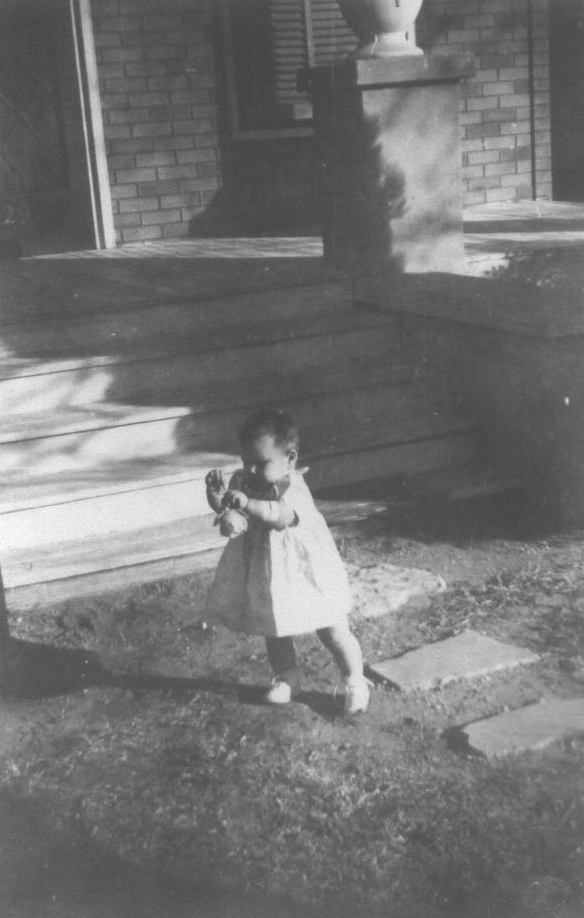
Last week as I was in the middle of re-posting my Thursday blog to several locations, something in the picture caught my eye. As I looked at the house in the background, something clicked. That house looked familiar in an odd way. You have to understand that that  photo had nothing written on the back of it to identify who was in the picture—I had just liked the look on the face of the woman. But the more that I looked at the house, the more I thought that I recognized it as my grandparents’.  The “bones” were the same—front door placement, windows placement, the height of the steps. The outside of the house was different. The posts were different. But my grandfather had bought the house sometime in the 1910s so it only make sense that some changes had been made in the sixty or so years that he owned it. I found a picture of the house (on Google Maps) as it looks now. It has siding covering it, as well as a metal handrail up the middle of the steps—the house was sold to an older couple years ago.

I remember the outside covered in a faux brick with concrete steps from a sidewalk up to the porch. The picture above was taken about 1949. Other than a block walkway and wooden (I think) steps, this is the way I remember the front of the house—even to the concrete planter on the concrete post on the porch by the steps.


All this led me to take a closer look at the woman in the picture from last week. Who was she? I enlarged the face as much as I could. The eyes look a lot like my grandmother who passed away when my father was nine years old. I compared her wedding picture (the only one we have of her as an adult) to the lady with the baby.  The lady with the baby has a fuller face. But if this is my grandmother, she would have been about twelve years (and two children, if the child she is holding is my aunt) older. My daughter and husband both looked at the picture and couldn’t decide if it was the same woman, but we all agree that it might be her mother. Unfortunately, the only picture I have of my great grandmother (She died in 1927, a year after her daughter.) is below and I don’t think that it is her in the picture with the baby:


So this still leaves me with my question—Is the woman with the baby the same woman who posed for her wedding picture twelve years earlier? Do I have a “new” picture of my grandmother? Below are the two pictures I have been comparing:


This was taken from her wedding photo:


AND


The above is an enlargement of the picture below:


Do you think these are the same woman?


Monday, July 24, 2017

Memory Monday: Just How Accurate Are Those Family Stories?


My daddy, his sister, and their cousin

JUST HOW ACCURATE ARE THOSE FAMILY STORIES?
As I was growing up, it was always an exciting time when we got to go to my mother’s parents’ home. There were often a lot of relatives since several of my mother’s siblings lived somewhat nearby. And then there were the times when one sister decided to come “home” and then one or more of the sisters would plan on coming at the same time. It was during these visits that I learned a lot of family history. Later, after I interviewed (and taped) these get-togethers with my mother, aunts, and grandmother. I am pretty sure the stories that I got were accurate—at least, as accurate as older women wanted to share.

Now stories from my father’s side of the family are a little sparse. One reason is my father had only one sibling—my mother had six. Another reason is my father’s sister lived far away and we hardly ever saw them. While we visited my dad’s parents, those visits were usually day trips. We would leave early Sunday morning, stop along the way and go to church, then get to my grandparents’ home in time for a late lunch. We hardly ever stayed the night. Usually, when we went we just played outside while the adults visited.

All that was said to explain why I don’t have a lot of stories of my father’s family. From a few things my dad had told me, I was able to piece together some of his side of the family. And thanks to Ancestry.com, I have also been able to learn more about that part of my family (and a bit more accurately). My sister told me that when she questioned my dad’s sister (our dad had already passed away when she needed this information for a college class) that she was told our grandfather had run away from home when he was eleven because his new step-mother was so mean. When I hear a story like that, I’m thinking he never went back home (and my aunt never said he returned). Well, when I looked at the census for when he was a little older, he is listed there living with his father and step-mother. He might have “run away” to his older brother’s house, which was only a few streets away, but he eventually came back home.

Another story I heard years and years ago, was that after my granddad married for the second time (my dad’s mother had died eight years before) was that my dad went to stay with his aunt (his mother’s sister) and her family during his last year in high school because she and her husband had lost a son the year before. I always thought the cousin who died was in his teens, like my dad—see the picture at the beginning of the article. I thought this was the cousin who had passed away. But today, I was to look at Ancestry.com to see if I could find just when this cousin passed away and what his name was. I got another surprise. While it is true that my aunt and her husband lost a son the year before my dad came to stay with them, the son that passed away died the same day he was born. I really think the reason that my father spent that year with his aunt’s family was he didn’t get along with his new step-mother—he called her “Madam” then and I never heard him call her anything but “Myrtle” as I grew up.


I think I need to spend more time on Ancestry.com. Maybe I will learn more about my dad’s family. I wonder what other stories that I’ve heard aren’t exactly true.

Monday, July 17, 2017

Memory Monday: Some of the Ways They Did Things Back Then


my grandmother with one of her children

SOME OF THE WAYS THEY DID THINGS BACK THEN

I was reading a book recently—Things Mother Used to Make, published in 1913. My grandmother, who was married in 1922, might have done some of these things. Here are a few items from that book that I found interesting—especially compared to the way we do things today:
To Save Confusion in the Home "Plan your work, then work your plan."
Monday—Wash, if you have it done in the house. If sent out, use that day for picking up and putting things in order, after the disorder of Sunday.
Tuesday—Iron.
Wednesday—Finish ironing and bake; wash kitchen floor.
Thursday, Friday—Sweep and dust, thoroughly.
Saturday—Bake, and prepare in every way possible, for the following day.

Homemade Shortening
Do not throw away small pieces of fat from pork, lamb or steak. Put them on the stove, in a skillet or agate dish and cook them till there is nothing left, but scraps. Then pare a potato, wash clean, cut into thin slices and cook in the fat for a half hour to clarify it. Strain through a cloth. This will be good to fry doughnuts in and for all purposes, where shortening is needed, except for pie crust.
Pieces of fat, not fit for shortening can be saved in some old utensil and made into kitchen soap.

Never Throw away Old Underclothes
Keep them for housecleaning, for washing windows and for washing lamp chimneys. Old pieces of calico or flannel make good holders to use about the stove. Wash, boil and dry cleaning cloths when soiled, that they may be ready for use again.

To Keep your Hands White
Keep a piece of lemon in your bathroom or kitchen. It will remove stains from the hands.

Save your Old Stockings
Old stockings are fine for cleaning the range. Slip your hand into the foot and rub hard, or place an old whisk broom inside. It will make the sides and front of the range clean and shiny. In fact, you will seldom need to use blacking on these parts.

To Remove Disagreeable Odors from the House
Sprinkle fresh ground coffee, on a shovel of hot coals, or burn sugar on the shovel. This is an old-fashioned disinfectant, still good.

To Lengthen the Life of a Broom
Your broom will last much longer and be made tough and pliable, by dipping for a minute or two, in a pail of boiling suds, once a week. A carpet will wear longer if swept with a broom treated in this way. Leave your broom bottom side up, or hang it.

To Soften Boots and Shoes
Rub them with kerosene. Shoes will last longer if rubbed over with drippings from roast lamb. Old-fashioned people always used mutton tallow on children's shoes.


Now aren’t these wonderful hints. Do you think you will use any of them? Really, aren’t you happy that you live today and not 100 years ago?

Monday, June 5, 2017

Memory Monday: A 19th Century Summer Bill of Fare


My Great-grandmother
A 19th CENTURY SUMMER BILL OF FARE
I was looking at some of my old editions of Worbly’s Family Monthly Magazine and came across something I thought was very interesting. It is from Mrs. Goodfellow’s Cookery As It Should Be, published in 1865. (My great-grandmother, pictured above would have been a young girl of 13 at that time.)
In this article, there is a summer’s Bill of Fare for the young housekeeper. Here is a suggested menu for a week in the summertime:
MONDAY.
Breakfast. Cold bread, fish, boiled eggs.
Dinner. Lamb and peas, calves' head, vegetables,
Dessert. Fruits.
Tea. Cold bread, light cake, fruit, curds and cream.
TUESDAY.
Breakfast. Cold bread, broiled ham, poached eggs.
Dinner. Ochra soup, fried chickens, calves' feet boiled, parsley sauce, vegetables.
Dessert. Fruit, floating island.
Tea. Cold bread, corn bread, fruits.
WEDNESDAY.
Breakfast. Cold bread, chops, boiled small hominy.
Dinner. Roast lamb, mint-sauce, green peas, boiled pigs' feet, parsley sauce, boiled tongue, vegetables.
Dessert. Pie, trifles.
Tea. Cold bread, toast, cream cheese, fruits.
THURSDAY.
Breakfast. Cold bread, fish, fried mush.
Dinner. Lobster, boiled mutton, stewed liver, vegetables
Dessert. Pudding and fruit.
Tea. Corn bread, light cake, stewed fruit.
FRIDAY.
Breakfast. Cold bread, clam fritters, boiled rice, and boiled eggs.
Dinner. Fish, beef steaks, vegetables.
Dessert. Pudding, fruit.
Tea. Corn bread, cold bread, fruit, cream cheese.
SATURDAY.
Breakfast. Corn bread, cold bread, fish and boiled eggs.
Dinner. Boiled fowls, egg or celery sauce, tongue, cutlets, vegetables.
Dessert. Pie, floating island, &c.
Tea. Cold bread, sliced tongue, fruit.
SUNDAY.
Breakfast. Cold bread, boiled ham and eggs, and small hominy.
Dinner. Roast beef, fricasseed chicken, vegetables.
Dessert. Fruit, jelly, or blanc-mange.
Tea. Cold bread, fish, fruits, light cake.

Now you have to realize that while I live in 2017, I write mid-19th Century historical fiction, a lot of the time about farmers or ranchers, not city dwellers who go to the butcher shops every day or two. So if the reader of this cookbook was a farm wife, Mrs. Goodfellow would, in one week, have the young housekeeper take apart a whole cow and serve it part by part. Notice: Monday—head, Tuesday—feet, Thursday—liver, Friday—hips or ribs (steaks), Saturday—tongue, and Sunday—hips or ribs again (roast). My question is: if this young farm wife uses all those parts one week, what is she supposed to do the next week when there is not head, feet, or tongue? Let her family starve? Or just give them more cold bread to eat? And why does the bread have to be cold? Why can’t she toast it or at least let it come to room temperature? And don’t even get me started on all this fish for breakfast? The one saving thing about this bill of fare is that there are plenty of desserts.

My final thought after reviewing this suggested menu for a week—Thank goodness for McDonald’s, Taco Bell, and Subway! With these three, I can eat all summer without worrying how I can find a cow’s head, tongue, and feet every week.

Monday, May 22, 2017

Memory Monday: More Tidbits on Manners from the Past


My Great-grandparents and Their Children

MORE TIDBITS ON MANNERS FROM THE PAST
As I was reading through some books on etiquette, I came across these tidbits in Matines’s Handbook of Etiquette, by Arthur Matine. It was published just after the American Civil War in 1866. My great-grandfather—the father pictured above—was born the same year.
I wonder how many of these were specifically taught to my great-grandparents by their parents.
Never read in company. A gentleman or lady may, however, look over a book of engravings with propriety.
It is a great thing to be able to walk like a gentleman—that is, to get rid of the awkward, lounging, swinging gait of a clown, and stop before you reach the affected and flippant step of a dandy. In short, nothing but being a gentleman can ever give you the air and step of one. A man who has a shallow or an impudent brain will be quite sure to show it in his heels, in spite of all that rules of manners can do for him.
In private, watch your thoughts; in your family, watch your temper; in society, watch your tongue.
Good sense must, in many cases, determine good breeding; because the same thing that would be civil at one time and to one person, may be quite otherwise at another time and to another person.
Frequent consultation of the watch or time-pieces is impolite, either when at home or abroad. If at home, it appears as if you were tired of your company and wished them to be gone; if abroad, as if the hours dragged heavily, and you were calculating how soon you would be released.
If you would have your children grow up beloved and respected by their elders as well as their contemporaries, teach them good manners in their childhood. The young sovereign should first learn to obey, that he may be the better fitted to command in his turn.
Show, but do not show off, your children to strangers. Recollect, in the matter of children, how many are born every hour, each one almost as remarkable as yours in the eyes of its papa and mamma.

How many of these do you think we should still be following today?


Monday, April 3, 2017

Memory Monday: Why Did They Do It Like This Back Then?


My Great-grandmother Emma

WHY DID THEY DO IT LIKE THIS BACK THEN?
While I was doing research for my historical magazine, Worbly’s Family Monthly Magazine (if you haven’t seen it, here is the link http://worblysmagazine.com/ ), I came across a cookbook that left me wondering a bit. It had an interesting section titled: MEDICINAL AND MISCELLANEOUS. Now I might be a bit odd at times, but normally I would put medical recipes and miscellaneous recipes in different sections—who knows, I might skip a line and bathe my feet with toast and cider if I didn’t.
Anyway, I wanted to share the names of the recipes that were grouped together in this section. Do you see any problem with the way it was done (the rest of the book was done as a traditional cookbook—meats, vegetable, pies, cakes, etc.)? The name of the book is The Improved Housewife, published in 1855—the same year my great-grandmother Emma was born.

Here are the recipes—in order—from the section MEDICINAL AND MISCELLANEOUS:
831. For Sprained Ankle.
832. Roast Apple Tea, and Acid Jelly.
833. Toast and Cider.
834. To Bathe the Feet.
835. R—f and R—y's Cure for Corns.
836. Mild Cathartic for Dispepsia.
837. Mustard Drafts.
838. Dropped Eggs.
839. For Teething Complaints of Children.
840. For Over Dose of Laudanum.
841. Chicken or Cracker Panada
842. For Prickly Heat.
843. Red Mixture, for Summer Complaint.
844. Ringworms.
845. Runaround.
846. Tobacco Salve. Royal.
847. For the Tetter.
848. To Stop Vomiting.
849. To Cure Seed Warts.
850. Toast Water.
851. Cure for Wens.
852. Cheap Cement for Bottles and Jars.
853. To make French Pomalum. Nice.
854. Southern Yellow Pickles.
855. Virginia Temperance Preserves.
856. Charleston Pudding.
857. Norfolk Spoonful Pudding.
And then they added these final two in the section—the only two that are not recipes:
858. General Rule
If a thing be worth doing at all, it is worth well doing:—best done, by self.
859. Punctuality
Fifteen minutes before the time.


Please help me—do you see the logic in this grouping? By the way, I just love this picture of my great-grandmother. I wish that I had known her.

Monday, February 6, 2017

Memory Monday: Facts in 1884


My Great-Grandfather

FACTS FROM 1884

I love to research. With writing historical romance, putting together my historical magazine, and finding things for my historical website, I need to do a lot of research (what fun!!!). As I was looking through the book, Hand Book of Useful Information, 1884, I came across this list:

Interesting Facts.
There are 2,750 languages.
America was discovered in 1492.
A square mile contains 640 acres.
Envelopes were first used in 1839.
Telescopes were invented in 1590.
A barrel of rice weighs 600 pounds.
A barrel of flour weighs 196 pounds.
A barrel of pork weighs 200 pounds.
A firkin of butter weighs 56 pounds.
Tile first steel pen was made in 1830.
A span is ten and seven-eighth inches.
A hand (horse measure) is four inches.
Watches were first constructed in 1476.
A storm moves thirty-six miles per hour.
A hurricane moves eighty miles per hour.
The first iron steamship was built in 183o.
The first Lucifer match was made in 1899.
Gold was discovered in California in 1848.
The first horse railroad was built in 1826-7.
The average human life is thirty-one years.
Coaches were first used in England in 1569.
Modern needles first came into use in 1545.
Kerosene was first used for lighting purposes in 1826.
The first newspaper was published in England in 1588.
The first newspaper advertisement appeared in 1652.
Until 1776 cotton spinning was performed by the hand-spinalist wheel.
Glass windows were first introduced into England in the eighth century.
Albert Durer gave the world a prophecy of future wood engraving in 1527.
Measure 209 feet on each side and you will have a square acre within an inch.
The first complete sewing machine was patented by Elias Howe, Jr., in 1846.
The first steam engine on this continent was brought from England in 1763.
The first knives were used in England and the first wheeled carriages in France in 1559.
The present national colors of the United States were not adopted by congress until 1777.


Although I haven’t cross-checked the information to see how accurate it is, I thought it was interesting to see what was being told as fact back then—like the speed of a storm or a hurricane—both of which we know by watching the news today isn’t exactly this cut and dry. By the way, this book came out about the time my great-grandparents had been married about nine years.